
An instrument built from a dead man’s head

Blake, C. J. (1876). [Photograph of the ear phonautograph] [Photograph]. Alexander Graham Bell Family Papers, Library of Congress. https://www.loc.gov/collections/alexander-graham-bell-papers/
In 1874, two years before he patented the telephone, Alexander Graham Bell collaborated with a Boston otologist named Clarence J. Blake on a device they called the ear phonautograph. It was meant to make speech visible for deaf students by tracing sound waves onto smoked glass. There was one unusual detail in its construction. Instead of an artificial diaphragm, Blake supplied an actual human middle ear, cut from a cadaver, complete with the tympanic membrane and ossicles (Sterne, 2003). A stylus was fixed to the ossicles. You spoke into the mouthpiece, the dead ear vibrated, and the vibration wrote.
Blake (1875) wrote about the technique in The Boston Medical and Surgical Journal as calmly as someone explaining a lab procedure. He mentioned that human membranes were preferred because they were easy to get in good condition. The ears used for this were likely from poor people, those executed, or unclaimed bodies.
This object is not just a historical item. It serves as the guide for every recording device in this unit. When I attached a microphone to my interview subject in Session 3, I wasn’t using a machine that imitates hearing. I was using a machine that was made from a mix of materials, and that mix came from a corpse.
The tympanic principle
Jonathan Sterne (2001, 2003) refers to this as the tympanic function. In The Audible Past, he argues that modern sound technologies operate on a similar principle: a membrane stretched across an opening, moved by air, which changes pressure into motion and then into a signal. Microphones, phonographs, telephones, and loudspeakers are all variations of this basic idea. Sound reproduction didn’t arise merely from a desire to replicate the world but grew from the study of the ear in the nineteenth century and a specific historical understanding of how we hear.
Salih, W. H. M. (2013). Morphological modeling and motion measurements of the middle ear using new X-ray stereoscopic and tomographic techniques [Doctoral dissertation/Thesis]. ResearchGate. https://www.researchgate.net/publication/235418964_Morphological_modeling_and_motion_measurements_of_the_middle_ear_using_new_X-ray_stereoscopic_and_tomographic_techniques
This changes the way we think about the story we create in a media lab. We usually believe that technology is neutral and the body is just what it records. However, Sterne’s history indicates the opposite: the body came first, was turned into a tool, and then this tool was sold back to us as something objective.
Understanding the body’s mechanics is important. Helmholtz (1863/1954) suggested that the inner ear functions like a bank of resonators, with each part reacting to a specific sound frequency. Georg von Békésy, who won the Nobel Prize in Physiology or Medicine in 1961 for his work on the cochlea, developed this idea into the traveling wave model. In this model, a wave travels along the basilar membrane, and the point along it that produces the greatest movement depends on frequency, with high frequencies peaking at one end and low frequencies at the other (Békésy, 1960). Frequency is understood as a place.

Olson, E. S., Duifhuis, H., & Steele, C. R. (2012). Von Békésy and cochlear mechanics. Hearing research, 293(1-2), 31–43. https://doi.org/10.1016/j.heares.2012.04.017
Now, take a look at the parametric EQ in Adobe Audition. It shows frequency on the horizontal axis, with positions ranging from low to high, allowing you to boost or cut a specific spot. This isn’t just a handy graph. It matches the structure of the basilar membrane. We created an interface that connects frequency to space because we are beings that relate frequency to space.
Multitrack editing is auditory scene analysis, outsourced
Albert Bregman’s (1990) Auditory Scene Analysis poses a question that seems simple until you attempt to program it. All sound in a room hits the eardrum as one pressure wave. How does the brain recognize that there are three different sources?
Bregman explains that the auditory system constantly groups sounds based on cues like harmony, timing, location, and continuity. Sounds that start together and share harmony are combined into one stream. The brain automatically separates these sounds.
A multitrack session involves playing back audio tracks to clarify them. In the Session 3 workshop, we put the interview voice on one track, the music on another, and room tone and commercial on a third. We were building the audio streams that a listener’s ear must separate. Each mixing choice is a guess about how others will perceive the sound.

Two lab techniques become clearer once you understand them. First, ducking means lowering the volume of the music when someone is speaking. This isn’t a matter of taste; it’s about clarity: if the music is too loud, it makes it harder to hear speech, especially the sounds that convey meaning. Second, crossfades help avoid sudden changes in audio. When the sound jumps abruptly, it creates a distracting click that our ears pick up on. The fade isn’t just to make it sound nicer; it’s necessary because our hearing developed in a world where sounds don’t appear instantly.
Compression as a fossil of the cochlea
The section about lossy and lossless compression can be quite surprising.
A lossless format like FLAC keeps the original sound exactly as it is. On the other hand, a lossy format focuses on something different. Sterne (2012) explains in MP3: The Meaning of a Format that perceptual codecs are designed based on a model of how we hear: a mathematical way of showing what sounds people generally don’t notice. The encoder figures out which sounds are too quiet to be heard when louder sounds are present and removes them, thinking no one will miss them.
So, MP3 isn’t just a way to compress audio; it’s more about compressing what we can hear. Behind every audio file I have, there’s a detailed model of the human ear, created from years of tests on a limited group of people. We started with a basic setup to capture sound and ended with a refined model built into a codec.

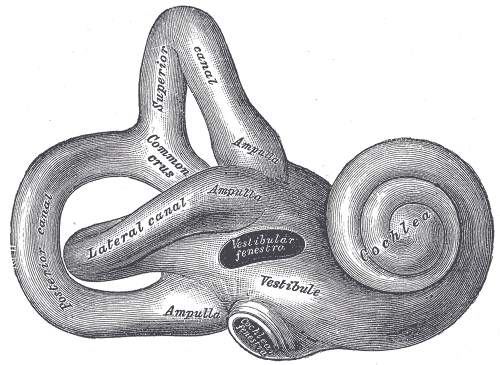
Rohr, L. (2015, August). Anatomy of the cochlea [Figure]. ResearchGate. https://www.researchgate.net/figure/Anatomy-of-the-cochlea-Source-OpenStax-College-95_fig3_28304464
Schizophonia and the ethics of the edit
If recording technology is designed like the ear, it takes on the ear’s credulity.
R. Murray Schafer (1977/1994) coined the term “schizophonia” to describe the gap between a real sound and its electronic version, arguing that this separation is important in modern life. Michel Chion (1994) built on this concept with acousmatic sound, which we hear without seeing its source. He noted that we tend to trust what we hear, even if it has been altered.

Proudfoot, C. (2024, March 12). Nipper and his master’s voice. Huguenot Museum. https://huguenotmuseum.org/about/news/nipper-and-his-masters-voice/
This relates directly to the interview I edited. Removing a stutter, shortening a pause, or shifting an answer to fit under a question were all changes you can’t hear. There’s no visible mark like an imperfect cut in a photo. Barry Truax (2001) argues that acoustic communication involves the listener, the sound, and the surroundings, rather than merely conveying bits of information. In this view, an undetectable edit isn’t just a technical move; it’s a breach of trust.
Conclusion
There is no clear line between how we hear biologically and how we record sound. A microphone acts like a fake eardrum, the EQ curve represents the ear’s structure, and multitrack sessions resemble our manual analysis of sound. An MP3 can be seen as a remnant of a listener’s experience. Bell and Blake’s device appears strange because it reveals what our inner tools still conceal. When I share my audio interview here, I am not just showing a recorded event; I am sharing the ongoing debate about the purpose of hearing.
References
- Békésy, G. von. (1960). Experiments in hearing (E. G. Wever, Ed. & Trans.). McGraw-Hill.
- Blake, C. J. (1875). The use of the membrana tympani as a phonautograph. The Boston Medical and Surgical Journal, 92(4).
- Bregman, A. S. (1990). Auditory scene analysis: The perceptual organization of sound. MIT Press.
- Chion, M. (1994). Audio-vision: Sound on screen (C. Gorbman, Ed. & Trans.). Columbia University Press.
- Helmholtz, H. von. (1954). On the sensations of tone as a physiological basis for the theory of music (A. J. Ellis, Trans.). Dover. (Original work published 1863)
- Schafer, R. M. (1994). The soundscape: Our sonic environment and the tuning of the world. Destiny Books. (Original work published 1977)
- Sterne, J. (2001). A machine to hear for them: On the very possibility of sound’s reproduction. Cultural Studies, 15(2), .
- Sterne, J. (2003). The audible past: Cultural origins of sound reproduction. Duke University Press.
- Sterne, J. (2012). MP3: The meaning of a format. Duke University Press.
- Truax, B. (2001). Acoustic communication (2nd ed.). Ablex.
Posts


Subscribe
Subscribe to get our latest stories in your inbox.
Leave a Reply